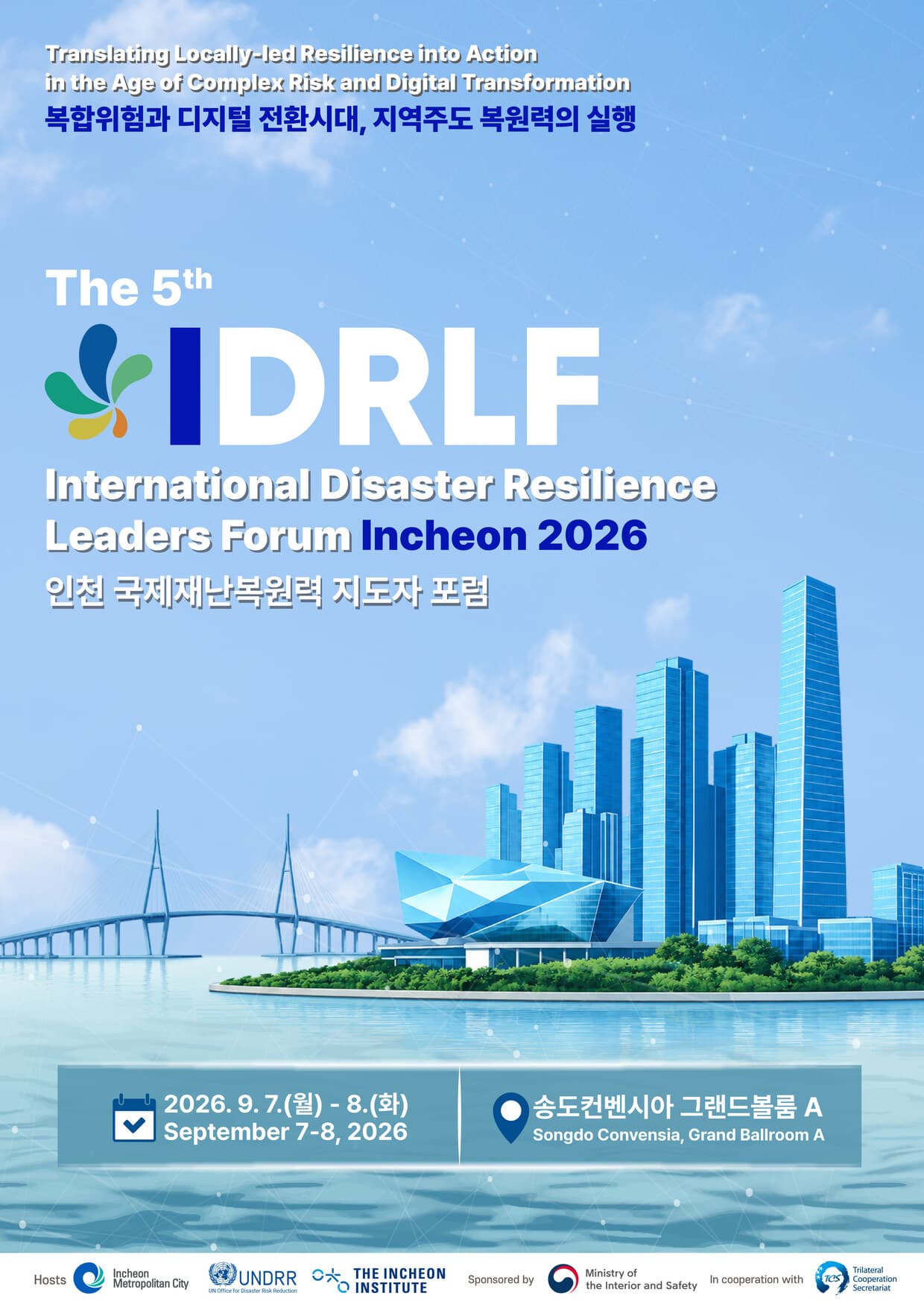
Since 2022, Incheon Metropolitan City, a recognized Resilience Hub under the Making Cities Resilient 2030 (MCR2030) initiative, has hosted the International Disaster Resilience Leaders Forum (IDRLF) as an annual platform to exchange practical solutions and lessons for building local and urban resilience in the face of growing disaster and climate risks. Co-organized with the Incheon Institute, the United Nations Office for Disaster Risk Reduction (UNDRR) Office for Northeast Asia and Global Education and Training Institute (ONEA & GETI), with the support of the Ministry of the Interior and Safety (MOIS) of the Republic of Korea, and in partnership with the Trilateral Cooperation Secretariat (TCS), the Forum brings together local leaders, national government officials, technical experts, and international organizations from Northeast and Southeast Asia and beyond.
Previous editions of the Forum highlighted the increasing exposure of cities to complex and interconnected risks, while also recognizing their role as engines of innovation and hubs of collaborative governance. IDRLF 2025 in particular demonstrated how international cooperation, financing, and multilevel partnerships can advance the implementation of disaster risk reduction (DRR) strategies at the local level, while underlying the significance of all-of-society approaches and capacity development as foundational pillars of resilience-building.
The 2026 edition of the Forum, which marks the 5th anniversary of this annual flagship event, will be held under the theme “Translating Locally-led Resilience into Action in the Age of Complex Risk and Digital Transformation.” IDRLF 2026 will focus on how disaster risk reduction can be effectively implemented at the local level in an increasingly complex and rapidly developing risk landscape. With the final five-year window of the Sendai Framework for Disaster Risk Reduction (2015–2030) underway, the Forum offers a timely opportunity to move beyond commitments and translate locally-led resilience into tangible action.
This focus reflects an increasing global recognition that, despite progress in developing national and local DRR strategies, significant gaps exist in their implementation, especially at the local level. The 2023 Midterm Review (MTR) of the Sendai Framework emphasized persistent challenges in disaster risk governance, financing, and capacity at the local level, and called for active support to local authorities in operationalizing DRR strategies and in bridging the gap between policy and practice.
At the same time, outcomes of the 8th Global Platform for Disaster Risk Reduction 2025 (GP2025), including the Geneva Call for Disaster Risk Reduction, highlighted the critical need to localize DRR efforts, scale up risk-informed investments, and leverage transformative technologies to solve systemic and compound risks. These priorities are further supported in the UNDRR Strategic Framework 2026–2030, which identifies the locally-led DRR, risk knowledge, financing, and recovery readiness as important areas for advancing resilience and guaranteeing that risk reduction efforts translate into measurable impact on the ground.
Building on this, the IDRLF 2026 aims to explore practical pathways to reinforce the implementation of DRR at the local level, including through the use of rising technologies such as artificial intelligence for disaster prevention and management; promoting risk-informed investments to support local resilience; enhancing recovery readiness and infrastructure resilience through forward-looking and participatory approaches; strengthening the science-policy interface to support evidence-based decision making; and sharing best practices from cities to facilitate peer learning and replication.
Through practical examples and experience sharing from countries and cities around the world, IDRLF 2026 seeks to demonstrate that disaster risk reduction is a shared responsibility, and that while resilience-building must be locally led, it requires sustained support from national, regional, and global levels. Strengthening linkages between local action and broader policy frameworks, while making collaboration across governments, academia, the private sector, and communities will be crucial to addressing complex and systemic risks and advancing sustainable development outcomes.
In addition, one of the core enabling factors for translating resilience into action is the availability and accessibility of financing. As emphasized in recent global discussions on disaster risk reduction financing, insufficient and inflexible funding represents a major obstacle to the effective implementation of local DRR strategies. In this regard, IDRLF 2026 will also explore how innovative financing mechanisms, strengthened public-private partnerships, and risk-informed investment approaches can better support locally-led resilience efforts and assist scale up action on the ground.
The two-day Forum will feature a series of thematic and networking sessions designed to facilitate experience sharing on successful international cooperation initiatives and effective local action for DRR. Participants will also be invited to join a tour of the Incheon Free Economic Zone (IFEZ) organized by the Incheon Tourism Organization and explore the city’s highlights.
The International Disaster Resilience Leaders Forum Incheon 2026 is organized by Incheon Metropolitan City, the Incheon Institute and the United Nations Office for Disaster Risk Reduction (Office for Northeast Asia and Global Education and Training Institute) on 7 and 8 September 2026, in Incheon, Republic of Korea, with the support of the Ministry of the Interior and Safety and in cooperation with the Trilateral Cooperation Secretariat.